
Both sides have now revealed a preference for escalation over strategic defeat, and each new provocation narrows the space for the next pause. The Touska seizure, Iran's refusal to negotiate under blockade, Israel's strikes on Iranian oil infrastructure -- all of these add up to an increasingly untenable situation. This makes the wild card -- Trump and his motormouth -- more consequential than ever, notes Prem Panicker in his must read blog on the Iran War.

India's real gross domestic product (GDP) is likely to grow at 7.5 per cent in FY26 and moderate to 7 per cent in the subsequent fiscal year, a domestic rating agency said on Wednesday.

Saudi Arabia and the UAE are actively pushing Trump to take the war to its bitter finish and 'erase' Iran's presence in the geopolitics of the region. Simply put, the two most powerful Sunni Arab oligarchies are on the same page as Israel. Such interference increases the risk of a breakdown in dialogue between the US and Iran, points out Ambassador M K Bhadrakumar.
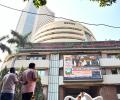
'BSE has facilitated nearly Rs 35 trillion in capital raising across multiple segments.'

India will maintain multiple sources for crude oil purchases and diversify them to ensure stability in the supply chain with national interests remaining the "guiding factor" for the procurement, Foreign Secretary Vikram Misri said.

'The day that the market realises that they've overspent (on AI) and there's a sudden collapse in the capex, then India can start outperforming again.'

When everyone has footage and no one can verify it, the loudest voice wins, notes Prem Panicker who begins a daily blog on the War in the Middle East.

High energy costs, long a drag on India's manufacturing competitiveness, are finally easing. Power and fuel expenses accounted for 1.98 per cent of net sales in 2024-25, the lowest level in data compiled by the Centre for Monitoring Indian Economy (CMIE) over the past two decades.

Taking a serious note of the situation, the civil aviation ministry said it has invoked regulatory powers to ensure fair and reasonable fares across all affected routes.

Moody's Investors Service on Friday said India's economy is expected to contract for the first time in more than four decades saying economic damage owing to the coronavirus-induced lockdown will be significant with lower consumption and sluggish business activity. Even before the coronavirus outbreak, Indian economy already was growing at its slowest pace in six years and with the stimulus measures announced by the government falling short of expectations, the disruptions are likely to be greater. "We now expect India's growth to register a real GDP contraction for the fiscal year ending in March 2021 (fiscal 2020-21), from our earlier projection of zero growth," it said in a research note.
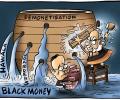
Assuming that demonetisation had not happened, the value of notes in circulation this year could have increased to Rs 19.3 lakh crore. But what we have, instead, by the end of August is a 20 per cent lower figure for currency notes in circulation, says A K Bhattacharya.

India should resist knee-jerk responses to tariff volatility in the US and instead use the current geopolitical churn to build manufacturing scale at home, former G20 Sherpa and former chief executive officer of NITI Aayog Amitabh Kant said on Wednesday.

New Delhi will substantially reduce tariffs on industrial and agricultural goods while continuing to protect sensitive sectors. Tariffs on some agricultural products that are not traditionally considered sensitive will be brought down to zero, while in the case of relatively sensitive items, duties will be reduced in a graded manner and quotas will be imposed.
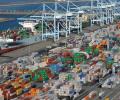
'The immediate impact for India will be very minimal as the share of Venezuela in our total overseas production is very low.'

'...not merely in managing fiscal mathematics, but in demonstrating conservatism and prudence within that framework.' 'Looking forward, we believe sufficient growth drivers exist -- ranging from government reforms to revival in consumption to favourable monsoons. Numerous factors support the Indian economy.'

What we are watching is something different: A fog manufactured and maintained by the people who started the war, so that the question of why it was started never has to be answered, observes Prem Panicker in his must read blog on the war in the Middle East.
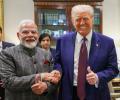
The agreement addresses non-tariff barriers and promotes increased trade in technology products and cooperation between the two countries.

While many areas compete for resources, defence, education, and adaptation deserve focus for maximum impact, suggests Laveesh Bhandari.

Her mission: Making Mother Earth cleaner and greener!
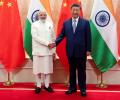
'China's basic purpose of taking the Shaksgam Valley was access to the Indian Ocean.'
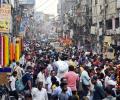
India will be the world's third-largest economy by 2028 as it becomes the world's most sought-after consumer market and gains share in global output, driven by macro stability influenced policy and better infrastructure, Morgan Stanley said. From a $3.5 trillion economy in 2023, the Indian economy is projected to expand to $4.7 trillion in 2026, which will make it the fourth largest in the world behind the US, China and Germany.

More than half of all new project announcements in the June 2025 quarter came from the manufacturing sector. Manufacturing projects worth around Rs 2.3 trillion were announced in the three-month period, accounting for 54 per cent of total new projects, according to data from the Centre for Monitoring Indian Economy (CMIE).

DGCA provided temporary relief to IndiGo, which is partially owned by Rahul Bhatia, by rolling back the night duty definition to 12 am-5 am from 12 am-6 am earlier, and allowing its pilots to do six night-landings from two earlier, besides other relaxations.

Quarterly earnings, macroeconomic data announcements and global trends will drive the Indian stock markets in a holiday-shortened week, analysts said. Stock markets would remain closed on Wednesday for the Guru Nanak Gurpurab holiday.


'Whether I am optimistic or pessimistic is not the issue; I am just going by the evidence available.' 'The Indian economy and financial sector are now well-placed and very resilient in dealing with any kind of spillover coming from the external world.'

Generative AI is transforming workplaces but at a cost -- there are fewer jobs for young workers just entering the workforce, reveals a Goldman Sachs report.

'Once the 60-plus population hits 20 to 30 per cent of the country, the demand for elderly-care treatments will surge -- cardiac, metabolic, neurological, and musculoskeletal medicines are going to dominate the market for the next several decades.'

RBI's interest rate decision, macroeconomic data announcements and global trends are the key factors that would dictate the momentum in the equity market this week, analysts said.

The Indian government has expressed its disagreement with the IMF staff's 'baseline' assumption that the 50 per cent US tariffs on its goods exports 'would remain in place indefinitely', based on which the staff pegged the country's GDP growth at 6.6 per cent this year, and pared its 2026-27 projection by 20 basis points to 6.2 per cent.

India's manufacturing sector activity eased in September, as new orders, output and input buying rose at the slowest rates in four months, while job creation retreated to one-year low, a monthly survey said on Wednesday.

Sri Lanka stays with you not just in memory, but gently reminds you what a society can achieve when heart and heritage guide the way.

AI will erase outsourcing jobs, redefine skills and disrupt global giants within five years, predicts Vinod Khosla. The IT legend urges young people to become generalists: Adaptable thinkers who can learn quickly, connect dots across disciplines and shift careers as technologies evolve.

If we persist in talk and little action, I think we will slip. I fear the consequences of sustained slow growth. We need strong, sustained, clever action today, Rajan said.

The prospect of protracted uncertainties in the global economic landscape not only pose a risk for India's growth outlook in 2025-26, but are also likely to dent the private sector's capital raising and investment plans, the finance ministry averred on Tuesday, cautioning the country's corporates that the era of 'easy pickings' was over.

ISRO Chairman V Narayanan announces ambitious space program goals, including landing Indians on the Moon by 2040 and launching the 'Gaganyaan' mission in 2027. The agency is also working on a national space station and uncrewed missions.

In the Indian stock market, investors are interested in the actions of both domestic and foreign institutional investors (FIIs and DIIs). These groups have wealth as well as expertise in research, which makes them powerful participants in the Indian stock market. Their buy and sell positions have a large effect on stock prices and market sentiment due to the large volume.

At the stroke of midnight, live dashboards lit up simultaneously across Amazon India's World Trade Centre headquarters and Flipkart's Outer Ring Road office in Bengaluru. In sprawling "war rooms" at both the companies, executives monitored real-time data streams tracking payment speeds, inventory levels, and delivery logistics as millions of shoppers flooded online platforms.

India's macroeconomic health is in a "relative goldilocks situation", and although the risk of higher landed oil prices, due to insurance cost surges and closure of choke points due to the brief Israel-Iran war, has receded, it is "too soon to sound the 'all clear' for the rest of the year", the Finance Ministry said on Friday.

'He knew the world's eyes were on him, and he had to speak directly to the fears that immigrants in New York feel right now.'
